Home Blog Page 2

SAIL Bhilai Steel Plant Apprentice Recruitment 2026: 710 Apprentice Posts, Eligibility, Stipend, Dates & Apply Online

0


SAIL Bhilai Steel Plant Apprentice- Apply Now

SAIL Bhilai Steel Plant Apprentice Recruitment 2026 notification has been released for 710 Apprentice posts for the 2026–27 training year. The notification was released on September 30, 2026, by Steel Authority of India Limited (SAIL), Bhilai Steel Plant. The vacancies are available for ITI, Diploma and Degree candidates under the Apprentices Act, 1961.

Candidates interested in SAIL Apprentice Recruitment 2026, Bhilai Steel Plant Apprentice 2026, ITI Apprentice Jobs, Diploma Apprentice Jobs and Graduate Apprentice Jobs should note that the online registration deadline is October 20, 2026. After online registration, eligible candidates have to attend the trade-wise walk-in process at Bhilai Steel Plant.

Manabadi provides the latest information on government jobs, apprenticeship opportunities, recruitment notifications, education and career updates. Candidates should always check the official notification before applying.

SAIL Bhilai Steel Plant Apprentice Recruitment 2026 – Overview

Particular Details
Organization Steel Authority of India Limited (SAIL)
Plant Bhilai Steel Plant (BSP)
Training Year 2026–27
Post Apprentice
Total Vacancies 710
Trade Apprentice (ITI) 516
Technician Apprentice (Diploma) 124
Graduate Apprentice 70
Application Mode Online Registration + Walk-in
Notification Date September 30, 2026
Last Date to Apply October 20, 2026
Walk-in Dates October 27 – November 21, 2026
Job Location Bhilai, Chhattisgarh


SAIL Bhilai Apprentice 2026 Important Dates

Event Date
Notification Released September 30, 2026
Online Registration/Application Starts September 30, 2026
Last Date for Portal Application October 20, 2026
Age Calculation Date October 31, 2026
Walk-in Process Starts October 27, 2026
Walk-in Process Ends November 21, 2026
Reporting Time 9:30 AM – 10:30 AM

SAIL Apprentice 2026 Vacancy Details

A total of 710 apprentice seats are available.

Apprentice Category Vacancies Monthly Stipend
Trade Apprentice – ITI 516 ₹9,600
Technician Apprentice – Diploma 124 ₹10,900
Graduate Apprentice – Degree 70 ₹12,300
Total 710 —

ITI Apprentice Posts

The 516 Trade Apprentice vacancies cover several ITI trades. Some of the major trades include:

  • Electrician – 95 posts
  • Fitter – 80 posts
  • Instrument Mechanic – 35 posts
  • Machinist – 25 posts
  • Manufacturing Process Control & Automation – 25 posts
  • Technician Mechatronics – 20 posts
  • Electronics Mechanic – 20 posts
  • Mechanic Refrigeration & AC – 20 posts
  • Turner – 15 posts
  • Welder – 15 posts
  • ICTSM – 15 posts
  • AOCP – 15 posts
  • Diesel Mechanic – 15 posts

Other trades include Tool & Die Maker, LACP, Mechanic Motor Vehicle, Central AC Plant Mechanic, Woodwork Technician, Stenographer, IT, Mason, Hospital Housekeeping and others.

Diploma and Graduate Apprentice Posts

The Technician Apprentice category has 124 seats, while the Graduate Apprentice category has 70 seats.

Disciplines include areas such as:

  • Civil
  • Electrical
  • Mechanical/Mechatronics
  • Metallurgy
  • Chemical
  • Computer Science
  • Information Technology
  • Electronics
  • Automobile
  • Production
  • Electronics & Instrumentation

The Graduate category also includes selected non-engineering qualifications such as BA, B.Sc, B.Com, BCA, BBA and B.Sc Nursing, while selected diploma-level healthcare qualifications are also included. Candidates should check the official vacancy table for the exact discipline-wise eligibility.

SAIL Bhilai Apprentice 2026 Eligibility

Educational Qualification

Candidates should have the required qualification in the relevant trade or discipline from a recognized institution.

ITI candidates: Relevant ITI qualification is required for Trade Apprentice posts.

Diploma candidates: Relevant Diploma qualification is required for Technician Apprentice posts.

Graduate candidates: Relevant Degree qualification is required for Graduate Apprentice posts.

Candidates must have passed their qualifying examination as regular candidates during 2022, 2023, 2024, 2025 or 2026. Candidates whose qualifying results are not declared by the application deadline are not eligible.

SAIL Apprentice 2026 Age Limit

The age limit is:

  • Minimum Age – 18 years
  • Maximum Age – 28 years
  • Age calculated as on October 31, 2026

Age relaxation will be applicable according to the relevant Government of Chhattisgarh guidelines.

Who Cannot Apply?

Candidates should carefully check the restrictions before applying.

Candidates who have already undergone or are currently undergoing apprenticeship training are not eligible.

Candidates with more than one year of work experience are also not eligible according to the recruitment conditions. Candidates who passed the required qualification before the specified period are also not eligible.–

SAIL Apprentice Selection Process 2026

One important point for candidates is that there is no written examination for this apprentice engagement.

Selection is based on academic merit, followed by the required walk-in/document verification process. Reports based on the BSP notice state that merit is calculated using the prescribed weightage of qualifying marks. Registration and attend the walk-in process on the date applicable to their trade or discipline.

SAIL Apprentice Walk-in Venue

Candidates who complete the online registration must attend the walk-in process at:

Room No. 123, Human Resource Development Centre (HRDC), Bhilai Steel Plant, Bhilai, Chhattisgarh – 490001.

The reporting time is 9:30 AM to 10:30 AM on the applicable date.

How to Apply for SAIL Bhilai Apprentice Recruitment 2026?

The application process is different depending on the qualification.

For ITI Candidates

ITI candidates need to register through the Apprenticeship India/NAPS portal.

After registration:

  1. Login to the apprenticeship portal.
  2. Go to Apprenticeship Opportunity.
  3. Search for SAIL BHILAI STEEL PLANT.
  4. Select the relevant trade.
  5. Submit the application.
  6. Download and keep a copy of the application.

For Diploma and Graduate Candidates

Diploma and Graduate candidates need to register through the NATS portal.

After registration:

  1. Login to the NATS portal.
  2. Go to Establishment Requests.
  3. Select Find Establishments.
  4. Search for Steel Authority of India Limited, Bhilai Steel Plant.
  5. Select the relevant discipline.
  6. Submit the application.
  7. Take a printout for the walk-in process.

Candidates should complete the online application before October 20, 2026.

Documents Required

Candidates should keep the following documents ready for verification:

  • 10th Class certificate/marksheet
  • ITI/Diploma/Degree certificate
  • Qualifying examination marksheets
  • Aadhaar Card or required identity document
  • Caste certificate, if applicable
  • PwD certificate, if applicable
  • Medical Fitness Certificate from a Government hospital
  • Apprenticeship registration/application copy
  • Bank account details/passbook as required for DBT
  • Self-attested copies of required documents

Candidates should carry the original documents along with the required self-attested copies to the walk-in process. GovtJobGuru.in

Application Fee

The available recruitment information indicates no application fee for the SAIL Bhilai Steel Plant Apprentice 2026 engagement. Candidates should still verify the latest instructions on the official notification before submitting their application. MySarkariNaukri

Important Points for Candidates

The last date to complete portal registration is October 20, 2026.

There are 710 total Apprentice seats.

516 seats are for ITI candidates, 124 for Diploma candidates and 70 for Graduate candidates.

There is no written examination.

Candidates must attend the walk-in process according to their trade/discipline.

The age limit is 18 to 28 years as on October 31, 2026.

Only candidates who passed the qualifying examination during 2022–2026 are eligible, subject to the other conditions.

This is apprenticeship training and should not be treated as a permanent SAIL job. The recruitment information states that BSP is not obligated to provide regular employment after apprenticeship training.

Conclusion

The SAIL Bhilai Steel Plant Apprentice Recruitment 2026 offers 710 apprenticeship opportunities for ITI, Diploma and Degree candidates for the 2026–27 training year. With ₹9,600 to ₹12,300 monthly stipend, multiple technical and non-technical disciplines, and no written examination, eligible candidates can consider applying through the prescribed apprenticeship portals.

Candidates should complete the online registration by October 20, 2026 and attend the trade-wise walk-in process from October 27 to November 21, 2026 with all required documents. For the latest notification and official updates, candidates should refer to SAIL’s official channels. SAIL’s official website identifies the company as a Government of India public sector undertaking under the Ministry of Steel.

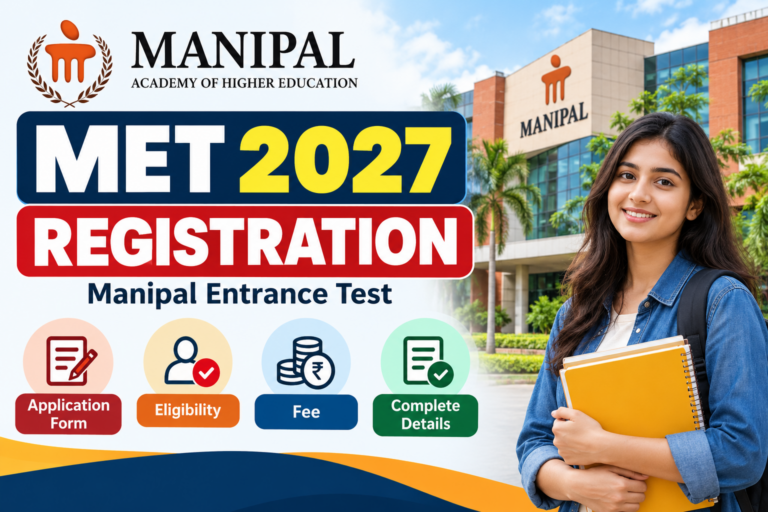
MET 2027 Registration: Manipal Entrance Test Application Form, Dates, Eligibility & Fee at Manabadi

0

The MET 2027 Registration process is expected to begin in the first week of October 2026. The Manipal Academy of Higher Education (MAHE) is expected to release the MET 2027 application form through its official admission portal. Candidates interested in B.Tech and other programmes can apply online once the application window opens.

MET 2027 Registration Dates

The following dates are tentative and may be updated by MAHE in the official notification:

Event Expected Date
MET 2027 Registration Begins First Week of October 2026
Phase 1 Application Last Date March 2027
MET Phase 1 Exam April 2027
MET Phase 2 Exam May 2027

Candidates should regularly check the official MAHE admission portal for the final schedule.

MET 2027 Eligibility Criteria

For B.Tech admission, candidates are expected to satisfy the following eligibility requirements:

Educational Qualification

Candidates must have passed Class 12 (10+2) or an equivalent examination from a recognized central or state board.

Required Subjects

Candidates must have studied:

  • Physics
  • Mathematics
  • English

In addition, candidates should have studied at least one of the following subjects:

  • Chemistry
  • Biotechnology
  • Biology
  • Technical vocational subject

Minimum Marks

Candidates should have secured at least 50% aggregate marks in Physics, Mathematics and one optional subject.

Candidates must also pass each of the required subjects individually.

Age Limit

There is no specific minimum or maximum age limit mentioned for applying to MET, subject to the applicable MAHE admission requirements.

MET 2027 Eligibility for Postgraduate Programmes

Candidates applying for postgraduate programmes at MAHE should check the programme-specific eligibility requirements before submitting their application. The requirements may differ depending on the course.

M.Tech Admission

Candidates seeking admission to M.Tech programmes generally need to meet the following requirements:

  • Qualifying Degree: B.E./B.Tech or an equivalent degree in a relevant discipline from a recognized university.
  • Minimum Marks: Candidates should generally have at least 50% marks or equivalent CGPA in their qualifying undergraduate degree.
  • Admission: Admission may be based on the applicable MET score or a valid GATE score, depending on the programme and admission category.

MBA Admission

Candidates applying for an MBA programme should generally meet these requirements:

  • Qualifying Degree: A Bachelor’s degree in any discipline from a recognized university.
  • Minimum Marks: At least 50% marks or equivalent CGPA in graduation.
  • Admission: Selection may consider scores from entrance examinations such as CAT, XAT, CMAT, MAT or ATMA, followed by the applicable selection process, which may include Group Discussion and Personal Interview.

Candidates should check the programme-specific admission notification for the latest eligibility and selection criteria.

MET 2027 Eligibility for NRI and International Students

MAHE also has an international admissions process for eligible Foreign Nationals, OCI/PIO cardholders and NRI students.

Academic Qualification

Candidates must have completed the required qualifying examination equivalent to the relevant Indian qualification. Students who have studied under international boards or outside India may need to provide an appropriate equivalency certificate, wherever applicable.

Engineering Eligibility

For undergraduate engineering programmes, international and NRI candidates are generally required to satisfy the prescribed subject and academic requirements, including the required combination of Physics, Mathematics and English.

Admission Process

Depending on the programme and admission category, eligible international or NRI candidates may be considered through a direct admission route or other prescribed admission criteria. Certain programmes may consider qualifying examination marks or standardized test scores instead of the regular MET route.

Candidates should carefully check the MAHE international admissions guidelines for the applicable documents, eligibility requirements, fees and admission procedure before applying.

Documents Required for MET 2027 Application

Candidates should keep the following details and documents ready before beginning the application:

  • Valid email ID
  • Active mobile number
  • Class 10 and Class 12 academic details
  • Scanned passport-size photograph
  • Scanned signature
  • Permanent address details
  • Parent/guardian details
  • Debit card, credit card, net banking or UPI details for fee payment

The photograph and signature should be uploaded according to the size, format and other specifications prescribed in the official application form.

MET 2027 Application Fee

The expected fee structure is:

Fee Component Amount
Application Fee ₹600
Examination Fee ₹1,400
Total ₹2,000

The actual fee may vary depending on the programme and choices selected by the candidate. Applicants should verify the final fee displayed on the official portal before making payment.

How to Apply for MET 2027?

Candidates can follow these general steps to complete the MET 2027 registration:

Step 1: Visit the Official Website

Visit the official Manipal Academy of Higher Education (MAHE) admission portal when the MET 2027 application link becomes available.

Step 2: Complete Registration

Click on the MET 2027 registration link and enter the required details such as:

  • Name
  • Email ID
  • Mobile number
  • Course preference
  • Other basic information

Step 3: Login to the Application Portal

Use the login credentials received after registration to access the application form.

Step 4: Fill in the Application Form

Enter personal, communication and academic details carefully. Candidates should make sure that the information matches their official documents.

Step 5: Upload Documents

Upload the required photograph and signature in the prescribed format and size.

Step 6: Pay the Application Fee

Pay the applicable registration and examination fee using the available online payment methods.

Step 7: Submit the Form

Review all the information entered in the application form before submitting it. After successful submission, candidates should save or download the confirmation page and payment receipt for future reference.

MET 2027 Exam Phases

MET is expected to be conducted in multiple phases. Based on the tentative schedule, Phase 1 may be conducted in April 2027, while Phase 2 may be conducted in May 2027.

Candidates should check the official notification for the exact examination dates, slot-booking procedure and other instructions.

MET 2027 Participating Campuses

MET scores are used for admission to various programmes offered by MAHE and its associated institutions. For B.Tech aspirants, the campuses associated with the admission process include:

  • MIT Manipal – Karnataka
  • MIT Bengaluru – Karnataka
  • MIT Sikkim – Sikkim
  • MIT Jaipur – Rajasthan

The programmes and campus options available may vary depending on the course and admission year.

MET 2027 Reservation Policy

The Manipal Academy of Higher Education (MAHE) does not follow the conventional caste-based reservation system generally applicable to government institutions. Admission to its programmes is primarily based on the applicable entrance examination, merit and programme-specific admission criteria.

Category-Wise Admission

MAHE has different admission categories and pathways for eligible candidates. These may include:

  • General / Domestic Candidates: Eligible candidates compete through the applicable admission process and merit criteria.
  • NRI / International Candidates: Separate admission provisions are available for eligible NRI, OCI/PIO and foreign-national candidates.

These categories should not be confused with caste-based reservations.

JEE Main Route for B.Tech

For certain B.Tech programmes, MAHE also provides an admission pathway based on JEE Main scores. The applicable number of seats, campuses, eligibility requirements and merit calculation can vary by admission year.

For example, the MAHE UG eligibility information has provided a JEE Main-based admission route for eligible B.Tech candidates at specified campuses. Candidates applying through this route must satisfy the prescribed Class 12 subject and percentage requirements in addition to the JEE Main criteria.

Important Note

Candidates belonging to SC, ST, OBC, EWS or other categories should not assume that government-style reservation quotas automatically apply to MAHE admissions. The applicable admission rules, category provisions and seat allocation criteria should be checked in the official MAHE admission notification for 2027, as these details may change from one admission year to another.

Important Points for MET 2027 Registration

  • Apply only through the official MAHE admission portal.
  • Enter your name and academic details carefully.
  • Keep your registered mobile number and email ID active.
  • Upload photographs and signatures according to the prescribed specifications.
  • Check the eligibility requirements before applying.
  • Pay the applicable fee before the deadline.
  • Save the application number and payment confirmation.
  • Check the official website regularly for updates regarding exam dates, slot booking, admit cards and results.

Conclusion

The MET 2027 Registration process is expected to start in October 2026, with the first examination phase likely to be conducted in April 2027. Candidates planning to pursue B.Tech through MAHE should check the eligibility requirements and keep their academic details and required documents ready in advance.

Since the dates and fee details mentioned above are expected/tentative, candidates should verify the final notification and application schedule released by MAHE before submitting the MET 2027 application.

RSSB Announces CET 2026 Revised Exam Calendar: Senior Secondary Test From December 1; Check Detailed Eligibility, OMR Guidelines & Exam Pattern at Manbadi

0

Jaipur: The Rajasthan Staff Selection Board (RSSB / RSMSSB), Jaipur, under the direction of Chairman Alok Raj, has issued an updated official examination schedule for the Common Eligibility Test (CET) 2026. The revision comes as a major relief for over 40 lakh registered applicants across Rajasthan, allowing extra time for preparation following schedule adjustments made due to state administrative arrangements and local body elections.

According to the revised notification, the CET Senior Secondary (12th) Level Examination 2026 will be held from December 1 to December 3, 2026 in dual daily shifts. Meanwhile, the CET Graduation Level Examination 2026 is scheduled for January 16 to January 18, 2027.

Rajasthan CET 2026: Comprehensive Revised Timetable

Level / Recruitment Exam Earlier Exam Dates Revised Official Exam Schedule
CET Senior Secondary Level 2026 October 23 – 25, 2026 December 1 – 3, 2026 (2 Shifts Daily)
CET Graduation Level 2026 December 1 – 3, 2026 January 16 – 18, 2027
Laboratory Attendant Recruitment — January 25, 2027
Junior Engineer (JE) Recruitment — February 3 – 5, 2027

Important Rules & Key Changes Introduced in CET 2026

  • Scorecard Validity Extended to 3 Years: The RSSB CET scorecard validity has been extended from 1 year to 3 years from the date of result publication.

  • Minimum Qualifying Cut-off: Candidates must secure a minimum of 40% marks (with a 5% relaxation for SC/ST candidates) to be eligible for secondary departmental recruitment notifications.

  • Implementation of 1/3rd Negative Marking: Every incorrect attempt will invite a penalty of 1/3rd () mark deduction.

  • Mandatory 5th Option (‘E’) in OMR Sheet:

    • Every question features 5 options: A, B, C, D, and E.

    • Option ‘E’ must be darkened if a candidate chooses not to attempt the question.

    • Leaving all 5 options unshaded triggers a 1/3rd negative mark penalty per question.

    • If a candidate leaves more than 10% of the total questions unattempted without darkening option ‘E’, they will face direct disqualification.

    • An extra 10 minutes of examination time is allotted exclusively to verify and darken unanswered questions with option ‘E’.

Detailed Exam Pattern & Marking Scheme

Senior Secondary Level CET Exam Pattern

  • Mode: Offline (OMR Sheet Based)

  • Total Questions: 120 Questions

  • Maximum Marks: 240 Marks

  • Duration: 2 Hours 30 Minutes ($+$10 extra minutes for 5th option check)

  • Marking: marks for each correct answer; () for incorrect answers.

Graduation Level CET Exam Pattern

  • Mode: Offline (OMR Sheet Based)

  • Total Questions: 150 Questions

  • Maximum Marks: 300 Marks

  • Duration: 3 Hours

  • Marking: marks for correct answer; () for incorrect answers.

Subject Breakdown & Syllabus Overview

Both examination papers evaluate candidates across seven key core areas:

  1. General Science & Computer Knowledge: Basic physics, chemistry, biology, life sciences, and introductory IT fundamentals.

  2. Rajasthan State Special Knowledge: History, art, culture, literature, geography, polity, and economic development of Rajasthan.

  3. Indian General Studies: Basic Indian Constitution, polity, geography, and current national events.

  4. General English: Sentence correction, idioms, phrases, direct-indirect speech, and comprehension.

  5. General Hindi: Grammar, sandhi, samas, synonyms, antonyms, and administrative terms.

  6. Quantitative Aptitude: Percentage, profit & loss, ratio, simple & compound interest, data interpretation.

  7. Logical Reasoning & Mental Ability: Analogies, coding-decoding, series, blood relations, and spatial reasoning.

Scope & Target Recruitment Posts

Clearing the CET exam serves as an entry gateway to appear in the secondary tier exams for government job openings in Rajasthan:

  • Under Senior Secondary CET: Rajasthan Police Constable, Lower Division Clerk (LDC Grade-II), Junior Assistant, Hostel Superintendent (Graded), and Laboratory Assistant.

  • Under Graduation Level CET: Patwari, Junior Accountant, Platoon Commander, Tehsil Revenue Accountant (TRA), Female Empowerment Supervisor, Deputy Jailor, and Hostel Superintendent Grade-II.

Instructions for Exam Day & Admit Card Details

  • Admit Card Issuance: Hall tickets will be made accessible online 7 to 10 days before the exam (around the last week of November 2026). Candidates must carry a printed admit card along with an original government-issued photo identity proof (preferably Aadhaar Card containing the complete birth date).

    Untitled
  • Reporting Time: Candidates must report 2 hours prior to the exam commencement. Exam center gates close strictly 1 hour before the scheduled start time.

    Untitled
  • Dress Code Requirements: Candidates must adhere strictly to the RSSB dress code (half-sleeve shirts/t-shirts, simple slippers, or ankle-length shoes/sandals without big buttons or metal embellishments). Watches, calculators, belts, and electronic gadgets are strictly banned inside the hall.

    Untitled

Direct Official Links

  • Official Website: rssb.rajasthan.gov.in

  • SSO Login Portal: sso.rajasthan.gov.in

    Frequently Asked Questions (FAQs) – RSSB Rajasthan CET 2026

    Q1. What are the new revised exam dates for Rajasthan CET 2026?

    Ans: As per the official notification, the CET Senior Secondary (12th) Level Exam will be conducted from December 1 to December 3, 2026, while the CET Graduation Level Exam will take place from January 16 to January 18, 2027.

    Q2. For how long is the RSSB CET 2026 scorecard valid?

    Ans: The CET scorecard will remain valid for 3 years from the date of result declaration.

    Q3. Is there negative marking in the RSSB CET 2026 examination?

    Ans: Yes, a strict negative marking scheme of $1/3^{\text{rd}}$ ($0.33$) mark deduction applies for every incorrect answer.

    Q4. What is the mandatory 5th Option (‘E’) in the OMR sheet?

    Ans: If you decide not to attempt a question, you must darken Option ‘E’. Leaving all options blank incurs a $1/3^{\text{rd}}$ mark penalty. Leaving more than 10% of total questions completely unshaded leads to direct disqualification.

    Q5. What is the minimum qualifying score required in CET 2026?

    Ans: Candidates must score a minimum of 40% marks (35% for SC/ST category candidates) to be considered qualified for upcoming state recruitment processes.

    Q6. When will the RSSB CET 2026 Admit Cards be released?

    Ans: Hall tickets will be published online on the official website (rssb.rajasthan.gov.in) approximately 7 to 10 days before the exam date (expected by the last week of November 2026).

    Conclusion

    The postponement of the Rajasthan Common Eligibility Test (CET) 2026 provides registered aspirants with an extended study timeline to align their preparation with the revised syllabus and exam pattern. Given the introduction of a 3-year scorecard validity, competitive candidate volume, and strict 1/3rd negative marking rules, candidates must focus on strategic revision, mock tests, and precise OMR filling techniques.

    Aspirants are strongly advised to regularly monitor the official RSSB portal (rssb.rajasthan.gov.in) or log in via their SSO ID for center updates, shift allotments, and official admit card download releases.

APPSC Mixed Cadre Recruitment 2026: 892 Vacancies, Eligibility, Salary, Dates and Application Details

0

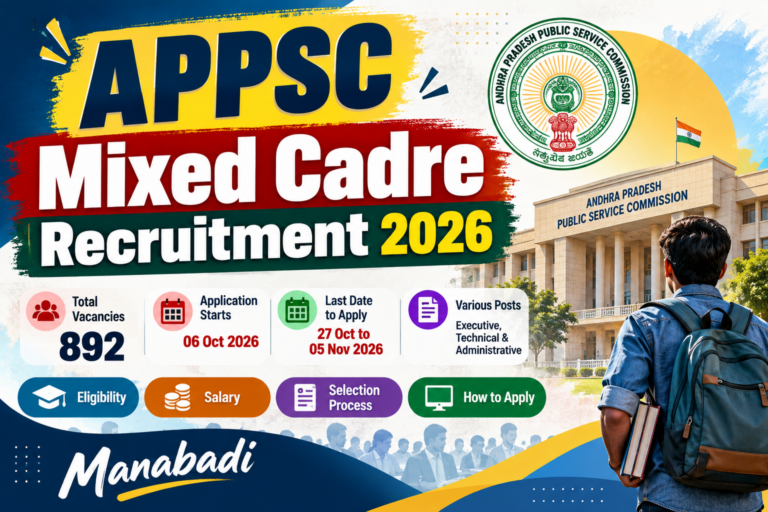
The Andhra Pradesh Public Service Commission (APPSC) released a major batch of recruitment notifications on September 15, 2026, covering 892 provisional vacancies across 20 notifications. The recruitment includes APPSC Group 1 Recruitment 2026, Assistant Statistical Officer, Executive Officer Grade-III, Industrial Promotion Officer, Forest Range Officer, Forest Beat Officer, Horticulture Officer, Hostel Welfare Officer and several other technical and departmental posts.

Candidates preparing for APPSC Recruitment 2026, APPSC Jobs 2026, APPSC Group 1 Notification 2026 and other government jobs in Andhra Pradesh should note that applications will open in different batches. The first application window is scheduled to begin on October 6, 2026, while some notifications will accept applications until November 5, 2026.

APPSC Mixed Cadre Recruitment 2026 – Overview

Particulars Details
Recruiting Organisation Andhra Pradesh Public Service Commission (APPSC)
Recruitment Year 2026
Notification Release Date September 15, 2026
Total Vacancies 892 Provisional Vacancies
Number of Notifications 20
Recruitment Type Direct / General Recruitment
Application Mode Online
First Application Start Date October 6, 2026
Last Application Date November 5, 2026
Official Website APPSC

APPSC 2026 Important Application Dates

Applications are not opening for all posts on the same day. Candidates must check the date applicable to their particular notification.

Notification / Post Application Start Last Date
Group-I Services October 6, 2026 October 27, 2026
Assistant Environmental Engineer October 6, 2026 October 27, 2026
Horticulture Officer October 6, 2026 October 27, 2026
Hostel Welfare Officer Grade-II October 9, 2026 October 29, 2026
Assistant Social/Tribal Welfare Officer October 9, 2026 October 29, 2026
Assistant Statistical Officer October 13, 2026 November 2, 2026
Analyst Grade-II October 13, 2026 November 2, 2026
English/Telugu Reporters October 13, 2026 November 2, 2026
Executive Officer Grade-III October 16, 2026 November 5, 2026
Industrial Promotion Officer October 16, 2026 November 5, 2026
Forest Range Officer / Forest Section Officer / Forest Beat Officer October 16, 2026 November 5, 2026

APPSC Recruitment 2026 – Post-Wise Vacancies

The 892 vacancies are spread across several departments and services. Some of the major vacancies are:

Post Vacancies
Group-I Services 163
Assistant Statistical Officer 196
Executive Officer Grade-III 104
Industrial Promotion Officer 78
Hostel Welfare Officer Grade-II 73
Assistant Environmental Engineer 40
Horticulture Officer 37
Forest Section Officer 26
Forest Beat Officer 23
Draughtsman Grade-II (Technical Assistant) 20
Analyst Grade-II 18
Assistant Director – Economics & Statistical Service 17
Assistant Social Welfare Officer / Assistant Tribal Welfare Officer 17
District Probation Officer / Intake Probation Officer 15
Inspector of Factories 12
English & Telugu Reporters 11
Assistant Director – Forensic Science Laboratory 8
Forest Range Officer 4
Assistant Director – Tribal Welfare 1

APPSC Assistant Statistical Officer Recruitment 2026

The Assistant Statistical Officer (ASO) recruitment is one of the largest individual recruitments in this batch, with 196 vacancies.

The post carries a pay scale of ₹37,640 to ₹1,15,500. The application window is scheduled from October 13 to November 2, 2026.

For ASO, candidates generally need a Bachelor’s Degree with Statistics as a main subject, or certain specified degree combinations involving Statistics. The exact qualification should be checked in the detailed notification before applying.

APPSC Executive Officer Recruitment 2026

APPSC has notified 104 Executive Officer Grade-III posts in the A.P. Endowments Subordinate Service.

Applications for these posts are scheduled from October 16 to November 5, 2026. The reported pay scale for Executive Officer Grade-III is ₹25,220–₹80,910.

APPSC Industrial Promotion Officer Recruitment 2026

A total of 78 Industrial Promotion Officer posts have been notified under the A.P. Industries Subordinate Services.

The application window is scheduled from October 16 to November 5, 2026. The reported pay scale is ₹54,060–₹1,40,540.

APPSC Forest Jobs 2026

The recruitment also includes several APPSC Forest Department Jobs 2026, including:

  • Forest Range Officer – 4 posts
  • Forest Section Officer – 26 posts
  • Forest Beat Officer – 23 posts
  • Draughtsman Grade-II (Technical Assistant) – 20 posts

Some forest posts have physical standards and other specific eligibility conditions, so candidates should carefully read the respective detailed notification.

APPSC Horticulture Officer Recruitment 2026

APPSC has notified 37 Horticulture Officer vacancies under the A.P. Horticulture Service.

The application period is scheduled from October 6 to October 27, 2026. The reported pay scale is ₹54,060–₹1,40,540.

APPSC Salary 2026

The salary differs according to the post and department. Some of the reported pay scales include:

Post Pay Scale
Assistant Statistical Officer ₹37,640 – ₹1,15,500
Executive Officer Grade-III ₹25,220 – ₹80,910
Industrial Promotion Officer ₹54,060 – ₹1,40,540
Horticulture Officer ₹54,060 – ₹1,40,540
Forest Range Officer ₹48,440 – ₹1,37,220
Forest Section Officer ₹32,670 – ₹1,01,970
Forest Beat Officer ₹25,220 – ₹80,910
Draughtsman Grade-II ₹34,580 – ₹1,07,210
Assistant Environmental Engineer ₹57,100 – ₹1,47,760
Inspector of Factories ₹65,360 – ₹1,54,980

Pay scales vary by post and should be confirmed from the relevant APPSC notification.

Since this recruitment contains 20 separate notifications, there is no single educational qualification for all 892 posts.

Depending on the post, candidates may need qualifications such as:

  • Bachelor’s Degree
  • Statistics / Mathematics / Economics / Commerce / Computer Science qualifications
  • B.E. / B.Tech
  • Horticulture qualification
  • Forestry-related qualifications
  • Diploma / ITI qualification
  • Other specialised qualifications

For example, the Assistant Statistical Officer post has specific degree requirements involving Statistics, while forest and technical posts have their own qualifications.

Therefore, candidates should not assume that a general degree is sufficient for every post.

APPSC Age Limit 2026

The age requirement is post-specific and must be checked in the detailed notification.

The brief notifications do not provide all the final age details for every post. In addition, the Andhra Pradesh Government has made changes to the upper-age rules for certain non-uniform services. Therefore, candidates should check the detailed notification applicable to their post before deciding eligibility.

APPSC Application Fee 2026

The application fee should also be checked against the individual detailed notification.

The brief notifications do not establish one common fee applicable to all 20 recruitments. Therefore, candidates should not rely on the commonly circulated ₹250 + ₹120 fee figure until the applicable detailed notification confirms it.

APPSC Selection Process 2026

The selection process will depend on the post.

Depending on the recruitment, candidates may have to appear for:

  • Computer-Based Recruitment Test (CBRT)
  • Written Examination
  • Computer Proficiency Test (CPT)
  • Physical standards/tests for certain uniformed or forest posts
  • Other post-specific selection stages

For example, the Assistant Statistical Officer notification specifies a single-level online CBRT, followed by a Computer Proficiency Test for qualifying candidates.

How to Apply for APPSC Recruitment 2026

Eligible candidates should follow these steps:

  1. Visit the official APPSC website.
  2. Complete the required OTPR/registration process.
  3. Select the relevant recruitment notification.
  4. Check the educational qualification, age, reservation and other eligibility conditions.
  5. Fill in the online application form.
  6. Upload the required documents as specified.
  7. Pay the applicable fee, if required.
  8. Submit the application before the post-wise last date.
  9. Download and save the application confirmation for future reference.

Conclusion

The APPSC Recruitment 2026 batch with 892 provisional vacancies provides opportunities across Group-I, statistical, welfare, forestry, horticulture, technical, endowments and other departments.

With applications opening in batches from October 6, 2026, candidates should identify the post that matches their qualification and carefully check the official APPSC detailed notification for eligibility, age limit, fee, syllabus, selection process and application deadline.

Do not wait until the last date to apply. Candidates should complete the application process well before the deadline and keep a copy of the submitted application for future reference.

For the latest APPSC Recruitment 2026, APPSC Group 1, AP Government Jobs, notification, syllabus, hall ticket and result updates, keep checking Manabadi.

Canara Bank Apprentice Recruitment 2026: 3,500 Graduate Apprentice Posts, ₹16,650 Stipend

0

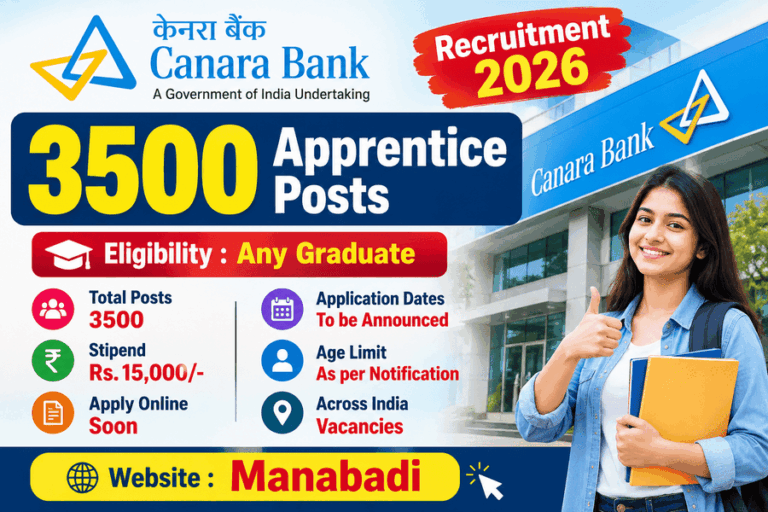
Canara Bank has announced a recruitment drive for 3,500 Graduate Apprentice posts for the financial year 2026–27. Eligible graduates can apply for the one-year apprenticeship training programme. The selection will be based on merit, and candidates will not have to appear for a written examination or interview.

Canara Bank Apprentice Recruitment 2026 – Overview

Particulars Details
Organization Canara Bank
Post Name Graduate Apprentice
Total Vacancies 3,500
Training Duration 12 Months
Monthly Stipend ₹16,650
Educational Qualification Graduation
Age Limit 20–28 Years
Selection Process Merit Based
Application Start Date October 1, 2026
Last Date to Apply October 17, 2026
Application Mode Online

Canara Bank Apprentice Vacancies 2026

Canara Bank is recruiting 3,500 Graduate Apprentices across India under the Apprenticeship programme for 2026–27. Candidates selected for the programme will undergo training for a period of 12 months.

During the apprenticeship period, candidates will receive a monthly stipend of ₹16,650.

Educational Qualification

Candidates applying for the Canara Bank Graduate Apprentice programme must have completed a Graduation Degree from a recognized university or institution.

Applicants are advised to check the official recruitment advertisement for the detailed qualification requirements applicable to their category and degree.

Age Limit

The prescribed age limit for the Canara Bank Apprentice Recruitment 2026 is 20 to 28 years.

Age relaxation may be applicable to candidates belonging to reserved categories as per the applicable government rules and the official notification.

Selection Process

One of the key features of this recruitment is that candidates are not required to appear for a written examination or interview.

Selection will be made through a merit list, with the merit being prepared based on candidates’ marks in Class 12/Intermediate or Diploma.

Candidates should carefully check the official notification for the exact merit calculation method and applicable tie-breaking criteria.

Canara Bank Apprentice Stipend

Candidates selected for the apprenticeship programme will receive a stipend of:

₹16,650 per month

The apprenticeship training will continue for 12 months.

Canara Bank Apprentice Recruitment 2026 Important Dates

The online application process is scheduled to begin on October 1, 2026.

Candidates will be able to submit their applications until October 17, 2026.

Event Date
Online Application Starts October 1, 2026
Last Date to Apply October 17, 2026
Training Duration 12 Months

Candidates should complete the registration and application process before the deadline to avoid last-minute technical issues.

How to Apply for Canara Bank Apprentice Recruitment 2026?

Eligible candidates need to complete the required registration on the National Apprenticeship Training Scheme (NATS) portal before proceeding with the Canara Bank application.

The general application process is as follows:

  1. Visit the NATS portal.
  2. Complete the required apprenticeship registration.
  3. Obtain the necessary registration details.
  4. Visit the official Canara Bank recruitment/careers page.
  5. Find the Graduate Apprentice Recruitment 2026–27 notification.
  6. Read the official notification carefully.
  7. Fill in the required details in the online application form.
  8. Upload the required documents.
  9. Submit the application before October 17, 2026.
  10. Download and save a copy of the submitted application for future reference.

Canara Bank Apprentice Recruitment 2026 Official Website

Candidates should rely on the official Canara Bank recruitment page for the notification, application link, detailed eligibility conditions, vacancy distribution and other instructions.

Canara Bank Official Recruitment Page

Important Note for Candidates

The Canara Bank Graduate Apprentice programme is an apprenticeship/training opportunity, not a regular permanent bank employee recruitment. Candidates should therefore read the official apprenticeship advertisement carefully before applying.

The 3,500 vacancies, stipend, eligibility, application dates and selection methodology should be verified against the official Canara Bank notification before submission.

Frequently Asked Questions

Q1. How many vacancies are available in Canara Bank Apprentice Recruitment 2026?
Canara Bank has announced 3,500 Graduate Apprentice vacancies for 2026–27.

Q2. What is the stipend for Canara Bank Apprentices?
Selected apprentices will receive a monthly stipend of ₹16,650.

Q3. What is the duration of the Canara Bank apprenticeship?
The training period is 12 months.

Q4. Is there a written exam for Canara Bank Apprentice Recruitment 2026?
As per the recruitment details provided, there is no written examination or interview. Selection is based on merit.

Q5. How will the merit list be prepared?
The merit list is based on marks obtained in 12th/Intermediate or Diploma, subject to the conditions specified in the official notification.

Q6. What is the age limit?
The stated age limit is 20 to 28 years, with applicable relaxations as per rules.

Q7. When will Canara Bank Apprentice applications begin?
The online application process is scheduled to start on October 1, 2026.

Q8. What is the last date to apply?
The last date for submitting the online application is October 17, 2026.

Q9. Where can candidates apply?
Candidates should first complete the required registration on the NATS portal and then follow the application instructions provided by Canara Bank.

Conclusion

The Canara Bank Apprentice Recruitment 2026 offers 3,500 Graduate Apprentice positions across India with a ₹16,650 monthly stipend and 12 months of training. Since selection is based on merit rather than a written examination or interview, eligible graduates should carefully check the official notification and complete the NATS registration and Canara Bank application within the prescribed dates.

AP High Court Civil Judge Recruitment 2026 Notification Out for 119 Posts: Apply Online for Junior Division Posts at Manabadi

0

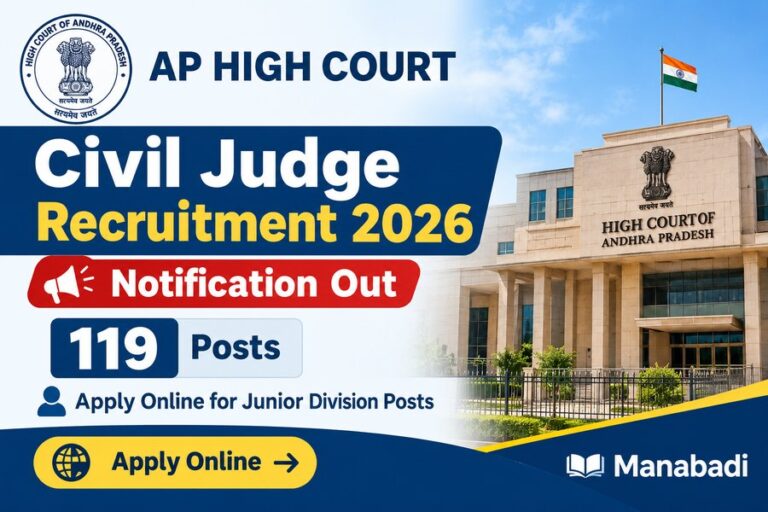
Andhra Pradesh High Court Notification 2026: High Court of Andhra Pradesh at Amaravati has officially released a comprehensive recruitment notification for the posts of Civil Judge (Junior Division) under the Andhra Pradesh State Judicial Service. A total of 119 vacancies are being filled through this notification, including 96 posts under Direct Recruitment and 23 posts through Recruitment by Transfer. Qualified law graduates seeking a high-profile judicial career in Andhra Pradesh can apply online starting from October 1, 2026 until October 26, 2026.

Below is the complete detail regarding total vacancies, category-wise post distribution, eligibility criteria, salary scale, exam pattern, selection process, and step-by-step application instructions in full detail.

AP High Court Civil Judge 2026: Summary Overview

Information Parameter Official Details
Recruiting Authority High Court of Andhra Pradesh, Amaravati
Name of Post Civil Judge (Junior Division)
Total Vacancies 119 Posts
Direct Recruitment 96 Posts
Recruitment by Transfer 23 Posts
Application Mode Online Only
Starting Date for Online Application October 1, 2026
Closing Date for Online Application October 26, 2026 (Till 11:59 PM)
Official Website aphc.gov.in
Pay Scale ₹77,840 – ₹1,36,520

Vacancy Break-up & Distribution Details

The overall recruitment drive covers 119 vacancies split under two distinct entry streams:

  1. Direct Recruitment Stream (96 Posts): Open for eligible fresh and practicing advocates holding a recognized Law degree.

  2. Recruitment by Transfer Stream (23 Posts): Reserved for eligible staff members working within the judicial system meeting the service condition requirements.

Salary & Compensation Package

Selected candidates joining as Civil Judge (Junior Division) will be appointed in the revised pay scale:

  • Pay Scale: ₹77,840 – ₹1,36,520

  • Allowances: In addition to the basic pay, appointed officers are entitled to Dearness Allowance (DA), House Rent Allowance (HRA), Judicial Allowances, medical facilities, official quarter accommodation, travel entitlements, and pension coverage under state service rules.

Eligibility Criteria: Age Limit & Educational Qualification

1. Educational Qualification

  • For Direct Recruitment: Candidates must possess a Bachelor’s Degree in Law (LLB) awarded by a Law University established by Law in India and recognized by the Bar Council of India. The candidate must be enrolled or eligible to be enrolled as an Advocate on the rolls of the Bar Council.

  • For Recruitment by Transfer: Candidates must hold a recognized Law Degree (LLB) and be an approved probationer/employee serving in designated ministerial/judicial cadres within the prescribed service experience rules.

2. Age Limit (As on September 1, 2026)

  • Direct Recruitment Stream:

    • General / Open Category (OC): Upper age limit is 35 years.

    • SC / ST / BC / EWS Candidates: Upper age relaxation of 5 years (up to 40 years).

    • Persons with Benchmark Disabilities (PwBD): Upper age relaxation of 10 years (up to 45 years).

    • Ex-Servicemen: Age relaxation applicable as per Andhra Pradesh State Judicial Rules.

  • Recruitment by Transfer Stream:

    • Maximum age limit is 48 years.

Application Fee & Payment Details

The registration fee must be remitted strictly through online payment gateways (Credit Card, Debit Card, Net Banking, UPI):

  • Open Category (OC) / BC / EWS Candidates: ₹1,500/-

  • SC / ST / PwBD Candidates: ₹750/-

Selection Process & Examination Scheme

The selection process for the AP High Court Civil Judge position is divided into three consecutive stages:

Stage 1: Computer Based Screening Test

  • Format: Objective Multiple Choice Questions (MCQs).

  • Total Questions / Marks: 100 Questions for 100 Marks.

  • Duration: 2 Hours (120 Minutes).

  • Purpose: Shortlisting candidates for the Written Main Examination in a 1:10 ratio per vacancy. Marks scored in the screening test are qualifying in nature and are not added to the final merit list.

Stage 2: Written Main Examination The written examination comprises three subjective/descriptive papers:

  1. Paper I – Civil Law: Covers Code of Civil Procedure, Contract Act, Transfer of Property Act, Specific Relief Act, Limitation Act, Evidence Act, and AP Land Laws (100 Marks).

  2. Paper II – Criminal Law: Covers Code of Criminal Procedure, Indian Penal Code, Indian Evidence Act, Protection of Women from Domestic Violence Act, Negotiable Instruments Act, and related local criminal laws (100 Marks).

  3. Paper III – English Translation & Essay Writing: Translation from Telugu to English, English to Telugu, and Legal Essay Writing (100 Marks).

Stage 3: Viva-Voce (Oral Interview)

  • Total Marks: 50 Marks.

  • Evaluates the candidate’s professional aptitude, legal acumen, personality, and suitability for judicial service.

Important Dates to Remember

  • Notification Release Date: Released officially on High Court Portal

  • Online Application Commencement Date: October 1, 2026

  • Last Date for Online Registration & Fee Payment: October 26, 2026 (11:59 PM)

  • Hall Ticket Download Date: To be announced on official website

  • Screening Test Date: To be notified shortly

How to Apply Online for AP High Court Civil Judge Recruitment 2026

Follow these steps to submit your online application on the official portal:

  1. Visit the official portal of Andhra Pradesh High Court: aphc.gov.in.

  2. Click on the notification link titled “Recruitment to the post of Civil Judge (Junior Division) – 2026”.

  3. Register on the portal by entering your Name, Date of Birth, Email ID, and Mobile Number to generate a Registration ID and Password.

  4. Log in using your credentials and fill out the detailed application form (Personal Details, Educational Qualifications, Category details, and Bar Enrollment info).

  5. Upload scanned copies of required documents (Passport Size Photograph, Signature, Class 10 Certificate, Law Degree Certificate, Category Certificate, PwBD/Ex-Servicemen certificates if applicable).

  6. Pay the prescribed application fee via online payment gateway.

  7. Verify all entered details using the Preview option before clicking Submit.

  8. Download and print a copy of the submitted application form and payment receipt for future reference.

Key Instructions & Guidelines for Applicants

  • Ensure that all uploaded certificates (Law degree, enrollment proof, caste certificate) are clear and valid.

  • Candidates applying under reservation categories must possess valid community certificates issued by competent authorities in Andhra Pradesh.

  • Applications submitted after October 26, 2026, or through offline modes will not be accepted under any circumstances.

  • Candidates are advised to keep their registered email address and mobile number active throughout the recruitment cycle for official notifications and updates.

    Here is the FAQs section written in direct prose without blockquotes or special formatting boxes:

    Frequently Asked Questions (FAQs) – AP High Court Civil Judge Recruitment 2026

    1. What is the total number of vacancies announced for AP High Court Civil Judge 2026? A total of 119 vacancies have been announced under the AP State Judicial Service. This includes 96 posts under Direct Recruitment and 23 posts under Recruitment by Transfer.

    2. What are the starting and ending dates for the online application? The online application portal opens on October 1, 2026, and the last date to submit applications is October 26, 2026, up to 11:59 PM.

    3. What is the educational qualification required to apply? Candidates applying for Direct Recruitment must possess a Bachelor’s Degree in Law (LLB) from a university recognized by the Bar Council of India, and must be enrolled or eligible for enrollment as an Advocate.

    4. What is the age limit and age relaxation for applicants? For Open Category (OC) candidates, the upper age limit is 35 years as of September 1, 2026. SC, ST, BC, and EWS candidates receive 5 years of age relaxation (up to 40 years), while PwBD candidates receive 10 years of relaxation (up to 45 years). For Recruitment by Transfer, the upper age limit is 48 years.

    5. How much is the application fee for different categories? The application fee is ₹1,500 for Open Category (OC), BC, and EWS candidates. For SC, ST, and PwBD candidates, the fee is ₹750. Payment must be made online.

    6. What is the pay scale for Civil Judge (Junior Division)? Selected candidates will be appointed in the pay scale of ₹77,840 to ₹1,36,520 along with applicable DA, HRA, and judicial allowances.

    7. What is the selection procedure for this recruitment? Selection involves three stages: a Computer Based Screening Test of 100 objective marks, a Written Main Examination consisting of three 100-mark papers (Civil Law, Criminal Law, and English Translation/Essay), and a 50-mark Viva-Voce (Oral Interview).

    8. Where and how can candidates submit their application? Applications must be submitted strictly online through the official High Court of Andhra Pradesh portal at aphc.gov.in. No offline applications are accepted.

    Conclusion

    The AP High Court Civil Judge Recruitment 2026 represents a landmark opportunity for law graduates and legal practitioners across Andhra Pradesh to step into prestigious judicial roles. With 119 vacancies open across Direct Recruitment and Recruitment by Transfer, selected candidates gain entry into a highly respected career path complete with an attractive pay scale of ₹77,840 to ₹1,36,520 and robust state service benefits.

    Aspirants are strongly advised not to wait until the final hours and to complete their online application process, fee payment, and document upload well before the October 26, 2026 deadline on the official portal (aphc.gov.in). Thorough preparation targeting the Computer-Based Screening Test and descriptive Main examination is the key to securing a position in the Andhra Pradesh State Judicial Service.

CG SET Admit Card 2026 Released: Download Hall Ticket, Exam Date, Timings and Guidelines

0

The CG SET Admit Card 2026 has been released on September 28, 2026, by the Chhattisgarh Staff Selection Board (CGSSB). Candidates appearing for the Chhattisgarh State Eligibility Test can download their hall tickets through the official CGSSB and Vyapam CG portals. The CG SET 2026 exam is scheduled to be conducted on October 4, 2026 in offline mode.

Candidates are advised to download the admit card well in advance and carefully check details such as their name, roll number, exam centre, reporting time and paper timings. The admit card is a mandatory document for appearing in the examination.

CG SET Admit Card 2026 – Overview

Particulars Details
Exam Name Chhattisgarh State Eligibility Test (CG SET) 2026
Conducting Body Chhattisgarh Staff Selection Board (CGSSB)
Admit Card Release Date September 28, 2026
CG SET Exam Date October 4, 2026
Exam Mode Offline / Written Examination
Paper-I Timing 10:00 AM to 11:15 AM
Paper-II Timing 2:00 PM to 4:15 PM
Admit Card Status Released
Official Portals cgssb.cgstate.gov.in / vyapamcg.cgstate.gov.in

CG SET Admit Card 2026 Released

The CG SET Hall Ticket 2026 is now available for candidates who successfully registered for the examination. The admit card contains important examination details, including the candidate’s personal information, roll number, examination centre and instructions to be followed on the exam day.

Candidates should verify all the information printed on the hall ticket. In case of any discrepancy, they should contact the concerned examination authorities before the examination date.

CG SET Exam Date 2026

According to the available examination schedule, the CG SET 2026 examination will be held on October 4, 2026 (Sunday).

The examination will be conducted in two sessions:

  • Paper-I: 10:00 AM to 11:15 AM
  • Paper-II: 2:00 PM to 4:15 PM

Candidates should reach the examination centre well before the reporting time to complete security checks and other examination formalities.

How to Download CG SET Admit Card 2026?

Candidates can follow these steps to download the CG SET 2026 Admit Card:

  1. Visit the official CGSSB portal or Vyapam CG website.
  2. Find and click on the CG SET Admit Card 2026 link.
  3. Enter the required login or registration details.
  4. Submit the details.
  5. The CG SET Hall Ticket will appear on the screen.
  6. Check all the details mentioned on the admit card.
  7. Download and save the admit card.
  8. Take a clear printout for the examination.

Candidates should keep the printed admit card safely until the completion of the examination process.

CG SET 2026 Exam Day Guidelines

Candidates appearing for the examination should follow all instructions mentioned on their admit card and those issued by the examination authorities.

Reach the Exam Centre Early

Candidates are advised to reach the examination venue at least two hours before the scheduled examination to allow sufficient time for security checks and verification procedures.

Carry Required Documents

Candidates should carry:

  • Printed copy of the CG SET Admit Card 2026
  • Valid original government-issued photo ID proof
  • Any other document specifically mentioned in the admit card

Accepted identity documents may include Aadhaar Card, PAN Card, Voter ID or Driving Licence, subject to the examination authority’s instructions.

Check Gate Closing Time

Candidates should carefully follow the gate-closing instructions mentioned for their respective examination session. Late entry may not be permitted after the prescribed closing time.

Avoid Prohibited Items

Candidates should not carry electronic gadgets or other prohibited items into the examination hall. Items such as mobile phones, smart watches and other electronic devices may not be permitted.

Candidates should also follow the instructions regarding bags, watches, jewellery and other personal belongings given by the examination authority.

Details Mentioned on CG SET Hall Ticket

After downloading the admit card, candidates should check the following details:

  • Candidate’s Name
  • Roll Number
  • Registration Number
  • Photograph and Signature
  • Examination Date
  • Paper Details
  • Examination Centre
  • Centre Address
  • Reporting Time
  • Paper Timings
  • Examination Instructions

If any important information appears incorrect, candidates should contact the concerned authorities immediately.

CG SET 2026 Preparation

With the examination scheduled for October 4, 2026, candidates should use the remaining preparation time effectively. Revision of important topics, previous question papers and mock tests can help candidates become familiar with the examination pattern.

Candidates should also keep their admit card and identity proof ready before the examination day to avoid las

KIITEE Management 2027 Application Begins: Check Important Dates, Exam Details and MBA Admission Process at Manabadi

0

The KIIT School of Management (KSOM) has officially started the KIITEE Management 2027 application process for candidates seeking admission to its MBA programme. Eligible candidates can apply online through the KIIT School of Management admission portal before the application deadline.

The KIITEE Management 2027 entrance examination will be conducted as a computer-based test (CBT) across 18 cities in India. Candidates planning to appear for the examination should complete the registration process within the prescribed deadline and carefully check the eligibility requirements and admission guidelines before submitting their applications.

KIITEE Management 2027 Important Dates

The important dates related to the KIITEE Management 2027 admission process are given below:

Event Date
Application Deadline January 4, 2027
Admit Card Release January 6, 2027
KIITEE Management 2027 Exam January 9 to 11, 2027
Result Declaration January 20, 2027
GD & PI Rounds First week of February 2027

Candidates are advised to complete their applications before the deadline to avoid last-minute technical issues or delays.

KIITEE Management 2027 Exam Details

The KIITEE Management 2027 examination will be conducted in computer-based test mode. The examination is scheduled to be held from January 9 to January 11, 2027, at designated centres across 18 cities in India.

After the entrance examination, the KIITEE Management 2027 results are scheduled to be announced on January 20, 2027. Shortlisted candidates will subsequently participate in the Group Discussion (GD) and Personal Interview (PI) rounds, which are scheduled for the first week of February 2027.

Alternative Entrance Exam Scores Accepted

Candidates who have already appeared for other recognised management entrance examinations may also be eligible for admission consideration through their valid scores.

KSOM accepts valid scores from:

  • CAT
  • XAT
  • MAT
  • CMAT
  • GMAT

Candidates with valid scores in these examinations can use them for the MBA admission process and may skip the KIITEE Management entrance examination, subject to the applicable admission criteria.

KIITEE Management 2027 Application Process

Candidates interested in the KIIT MBA programme should complete the online application process through the KIIT School of Management admission portal.

While submitting the application form, candidates should carefully enter their personal, academic, and contact details. They should also verify all information and complete the application process before the prescribed deadline.

Candidates are advised to keep the required academic records, identity details, photographs, and other supporting information ready before beginning the registration process.

KIITEE Management 2027 MBA Admission

The MBA admission process at KIIT School of Management will involve the entrance examination or consideration of eligible alternative entrance exam scores, followed by the applicable selection process. Candidates shortlisted for the next stage will be required to participate in the GD and PI rounds.

The final admission process will be carried out according to the eligibility requirements and admission criteria prescribed by KSOM.

KIITEE Management 2027: Eligibility, Fee Structure and Scholarships

The KIIT School of Management (KSOM) MBA Admission 2027 has specific eligibility requirements related to academic qualifications, minimum marks, and entrance examination scores. Candidates should check the applicable admission conditions before submitting their application.

KIIT School of Management MBA Eligibility Criteria

Candidates applying for the KSOM MBA programme must meet the following eligibility requirements:

  • Academic Qualification: Candidates should hold a graduate degree or equivalent qualification in any discipline recognised by the Association of Indian Universities (AIU), following a 10+2+3 or 10+2+4 education pattern.
  • Minimum Marks: Candidates should have secured at least 50% aggregate marks or equivalent CGPA in Class 10, Class 12, and Graduation.
  • Final-Year Students: Candidates appearing in the final year of graduation can also apply. Their admission will remain provisional until they submit proof of fulfilling the required 50% graduation criteria by September 30, 2027.
  • Age Limit: There is no minimum or maximum age limit for applying to the programme.
  • Entrance Exam Exemption: Candidates with a valid score in CAT, XAT, MAT, CMAT, or GMAT can apply using their qualifying national-level management entrance score and are not required to appear for the KIITEE Management 2027 entrance examination, subject to the applicable KSOM admission criteria.

KIIT MBA 2027 Fee Structure

The total fee for the two-year residential MBA programme is ₹18,00,620, according to the fee details provided for the programme. The fee structure includes components such as tuition, air-conditioned hostel accommodation, mess charges, books, study materials, and a laptop.

Fee Type / Installment Amount
Application Form Fee ₹1,500
One-time Admission Fee ₹1,00,000
Semester 1 to 4 Installments ₹4,25,155 per semester
Total Program Fee ₹18,00,620

Candidates should verify the latest fee structure and payment schedule on the official KSOM admission portal before making any payment, as fees and applicable components may be subject to change.

KIIT School of Management MBA Scholarships

KSOM also provides scholarships for eligible meritorious students. As per the stated scholarship criteria, a 50% tuition fee waiver is available at the time of admission for candidates meeting specified performance criteria.

KIITEE Management 2027 Exam Pattern and Syllabus

The KIITEE Management 2027 exam pattern and syllabus are designed to assess candidates across key areas such as English, Quantitative Aptitude, Analytical Reasoning, and General Knowledge. The examination is conducted entirely in computer-based test (CBT) mode.

KIITEE Management 2027 Exam Pattern

The KIITEE Management 2027 question paper consists of 120 multiple-choice questions (MCQs) carrying a total of 480 marks. Candidates will have 150 minutes (2.5 hours) to complete the examination.

  • Total Questions: 120
  • Maximum Marks: 480
  • Duration: 150 minutes
  • Mode: Computer-Based Test (CBT)
  • Marking Scheme: +3 marks for every correct answer, -1 mark for every incorrect answer, and 0 marks for unattempted questions.
  • Sectional Time Limit: There is no sectional time limit, allowing candidates to switch between sections during the examination.

KIITEE Management 2027 Section-Wise Weightage

Section Number of Questions Total Marks
English 40 120
Quantitative Aptitude 30 90
Analytical Reasoning 30 90
General Knowledge 20 60
Total 120 480

KIITEE Management 2027 Syllabus

The KIITEE Management syllabus covers topics related to language skills, numerical ability, logical reasoning, and general awareness. The overall difficulty level is generally considered moderate, with the examination pattern having similarities with other management entrance examinations.

English

The English section consists of 40 questions and tests candidates’ language and verbal ability. Important topics include:

  • Reading Comprehension
  • Grammar
  • Vocabulary
  • Synonyms and Antonyms
  • Idioms and Phrases
  • Para-jumbles
  • Verbal Reasoning

Candidates should focus on improving their reading speed, vocabulary, grammar, and comprehension skills.

Quantitative Aptitude

The Quantitative Aptitude section contains 30 questions and assesses candidates’ numerical and mathematical skills. Important topics include:

  • Arithmetic
  • Algebra
  • Geometry
  • Number System
  • Data Interpretation
  • Charts and Graphs
  • Probability

Candidates should practise calculations regularly and focus on improving speed and accuracy.

Analytical Reasoning

The Analytical Reasoning section includes 30 questions designed to test logical thinking and problem-solving ability. Important topics include:

  • Seating Arrangements
  • Puzzles
  • Blood Relations
  • Coding-Decoding
  • Syllogisms
  • Logical Reasoning
  • Analytical Reasoning

Regular practice of reasoning questions can help candidates improve their ability to identify patterns and solve problems efficiently.

General Knowledge

The General Knowledge section consists of 20 questions and covers a range of topics related to current and general awareness, including:

  • Current Affairs
  • Business and Economy
  • Sports
  • Historical Events and Milestones
  • General Awareness

Candidates should regularly follow important national and international developments, particularly those related to business, economy, education, sports, and current affairs.

How to Prepare for KIITEE Management 2027

Candidates preparing for KIITEE Management 2027 should create a structured study plan covering all four sections. Since there is no sectional time limit, candidates can develop a strategy based on their strengths and weaknesses and allocate examination time accordingly.

Regular mock tests, previous practice questions, timed exercises, vocabulary revision, quantitative practice, and current affairs preparation can help candidates become familiar with the examination format and improve their speed and accuracy.

Conclusion

The KIITEE Management 2027 application process has begun, providing MBA aspirants an opportunity to apply for admission to KIIT School of Management. Candidates interested in appearing for the entrance examination should complete their registration by January 4, 2027, and keep track of the admit card, examination, result, GD and PI dates.

Candidates should regularly check the official KIIT School of Management admission portal for any changes or additional instructions related to the KIITEE Management 2027 admission process.

Bank of Baroda LBO Admit Card 2026 Out: Download Hall Ticket, Exam Date & Direct Link

0

Bank of Baroda LBO Admit Card 2026 

The Bank of Baroda LBO Admit Card 2026 has been released on September 27, 2026 for candidates who applied for the Local Bank Officer (LBO) Recruitment 2026. The recruitment drive is being conducted for 2,482 Local Bank Officer vacancies in Junior Management Grade/Scale-I. Candidates can now download their BOB LBO Admit Card 2026 from the official Bank of Baroda website using their registration number/roll number and password or date of birth.

The Bank of Baroda LBO Exam 2026 is scheduled to be conducted on October 3, 2026, in online mode. Candidates should download their BOB LBO Hall Ticket 2026 as early as possible and carefully check the examination centre, reporting time, shift and instructions printed on the call letter.

Manabadi provides the latest updates on government jobs, bank recruitment, admit cards, examination dates, results and career opportunities. Candidates preparing for the Bank of Baroda LBO Exam 2026 can follow Manabadi for important updates, exam information and other recruitment news.

Bank of Baroda LBO Admit Card 2026 – Overview

Particulars Details
Organization Bank of Baroda
Post Local Bank Officer (LBO)
Recruitment BOB LBO Recruitment 2026
Total Vacancies 2,482
Admit Card Release Date September 27, 2026
Exam Date October 3, 2026
Exam Mode Online/Computer-Based Examination
Job Grade Junior Management Grade/Scale-I
Selection Process Online Examination + Local Language Test
Official Website bankofbaroda.bank.in


Bank of Baroda LBO 2026 Important Dates

Event Date
Online Application Started August 18, 2026
Last Date to Apply September 17, 2026
Exam Date Notice September 23, 2026
BOB LBO Admit Card Released September 27, 2026
BOB LBO Online Examination October 3, 2026

How to Download Bank of Baroda LBO Admit Card 2026

Candidates can follow the steps below to download their BOB LBO Hall Ticket 2026:

Step 1: Visit the Official Website

Visit the official Bank of Baroda website and go to the Careers/Current Opportunities section.

Step 2: Find the LBO Recruitment Link

Look for the recruitment notification related to Local Bank Officers 2026.

The official recruitment page contains the relevant recruitment documents and examination notification.

Step 3: Open the Admit Card Link

Click on the link for the LBO Online Examination Call Letter/Admit Card.

Step 4: Enter Login Details

Enter the required credentials, such as:

  • Registration Number/Roll Number
  • Password/Date of Birth

Step 5: Submit Details

Click on the Submit/Login button.

Your BOB LBO Admit Card 2026 will appear on the screen.

Step 6: Download and Print

Download the admit card and take a clear printout.

Candidates should preserve the admit card safely until the examination and subsequent recruitment stages are completed.

Details Mentioned on BOB LBO Hall Ticket 2026

After downloading the admit card, candidates should carefully verify all the details printed on it.

Check the following:

  • Candidate Name
  • Roll Number
  • Registration Number
  • Photograph
  • Signature
  • Exam Date
  • Exam Shift
  • Reporting Time
  • Examination Centre
  • Centre Address
  • Exam Instructions

If there is any discrepancy in the information, candidates should contact the concerned authority through the official channels mentioned by Bank of Baroda.

BOB LBO Exam Day Documents Required

Candidates should carry the documents mentioned in their call letter. Generally, candidates should be prepared with:

  • Printed copy of the BOB LBO Admit Card
  • Original valid photo ID proof
  • Photocopy of the photo ID, if required by the examination instructions
  • Recent passport-size photographs, if specified in the call letter

Acceptable identity documents may include Aadhaar Card, PAN Card, Voter ID, Passport or another permitted government-issued photo ID.

Candidates must follow the exact document requirements mentioned on their individual admit card and official examination instructions.

BOB LBO Exam Day Instructions

Candidates appearing for the examination should keep the following points in mind:

  • Reach the examination centre well before the reporting time.
  • Carry a printed copy of the admit card.
  • Carry the required original photo ID proof.
  • Check the exam centre address before leaving home.
  • Follow all instructions mentioned on the call letter.
  • Do not carry prohibited items into the examination centre.
  • Make sure that the photograph and other details on the admit card are clearly visible.

Do not wait until the last day to download the admit card.

BOB LBO Recruitment 2026 – Selection Process

The Bank of Baroda LBO recruitment selection process includes an Online Examination followed by a Local Language Test (LLT), as applicable under the recruitment process.

Candidates should check the detailed recruitment notification for the complete selection process, eligibility requirements and applicable conditions.

BOB LBO 2026 Vacancy Details

Bank of Baroda is recruiting 2,482 Local Bank Officers under the 2026 recruitment drive. The posts are in Junior Management Grade/Scale-I.

The recruitment is being conducted on a regular basis, with the bank stating that the recruitment drive is intended to support regional growth.

What Candidates Should Do After Downloading the Admit Card

After downloading the Bank of Baroda LBO Admit Card 2026, candidates should:

  1. Check the exam date and shift.
  2. Verify the examination centre address.
  3. Check the reporting time carefully.
  4. Arrange the required photo ID proof.
  5. Keep a printed admit card ready.
  6. Check the examination instructions.
  7. Plan the route to the examination centre in advance.
  8. Reach the venue before the reporting time.

Conclusion

The Bank of Baroda LBO Admit Card 2026 is now available, with the hall ticket released on September 27, 2026. Candidates appearing for the BOB LBO Exam 2026 should download their call letter, verify their examination centre and reporting time, and carefully follow all instructions mentioned on the admit card.

The BOB LBO online examination will be conducted on October 3, 2026, for 2,482 Local Bank Officer vacancies. Candidates should complete their exam-day preparations in advance and carry all mandatory documents to the examination centre.

For the latest Bank of Baroda LBO Admit Card 2026, BOB LBO Exam Date, Hall Ticket, Exam Pattern, Results and Bank Jobs updates, stay connected with Manabadi.

Suggested SEO keywords: Bank of Baroda LBO Admit Card 2026, BOB LBO Admit Card 2026, BOB LBO Hall Ticket 2026, Bank of Baroda LBO Exam Date 2026, BOB LBO Exam 2026, BOB Local Bank Officer Admit Card, BOB LBO Hall Ticket Download, Bank of Baroda LBO Recruitment 2026, BOB LBO Exam Date October 3 2026.

Seva First Innovation Challenge 2026 Launched at IISc Bengaluru: Check Registration, Eligibility, Themes, Prizes and Dates

0

The Seva First Innovation Challenge (SFIC) 2026 has been officially launched at the Indian Institute of Science (IISc), Bengaluru, providing students and young innovators an opportunity to identify real-world problems and develop practical solutions that can potentially be tested, scaled and adopted.

The Union Minister for Education, Shri Pralhad Joshi, inaugurated the South Zone edition of the challenge at IISc Bengaluru on September 25, 2026, and launched the official SFIC website and registration portal. IISc Bengaluru is serving as the South Zone Nodal Institute for the initiative.

The challenge is being organised jointly by the Ministry of Education, All India Council for Technical Education (AICTE) and University Grants Commission (UGC), with IISc Bengaluru serving as the nodal institute. The initiative is designed to encourage young people to move from identifying community problems to developing solutions that have a possible pathway towards implementation.

The registration and submission window is open from September 25 to October 24, 2026. The official portal states that the initiative will subsequently move through screening, evaluation, mentoring and showcase stages, with the national finale scheduled for New Delhi in December 2026.

Seva First Innovation Challenge 2026: Latest Update

The Seva First Innovation Challenge 2026 has been officially launched.

The initiative is aimed at students and young innovators from different educational levels, including schools, Industrial Training Institutes (ITIs), polytechnics, colleges and universities.

The challenge focuses on problems faced by communities and citizens and encourages participants to develop solutions under five broad national themes. Participants can submit either a Product or Technology Solution or a Business Model or Governance Solution.

The official SFIC portal describes the initiative as an effort to nurture the innovation and entrepreneurial potential of young people and connect promising ideas with mentorship, laboratories, incubation, pilot support and possible adoption pathways.

Seva First Innovation Challenge 2026: Key Highlights

Particular Details
Challenge Seva First Innovation Challenge 2026
Short Name SFIC 2026
Launch Date September 25, 2026
Launch Venue Indian Institute of Science, Bengaluru
Nodal Institute IISc Bengaluru
Organisers Ministry of Education, AICTE and UGC
Registration Begins September 25, 2026
Registration Last Date October 24, 2026
Participation Levels Junior, Technical and Open
National Themes 5
Innovation Tracks 2
National Finale New Delhi, December 2026
First Prize ₹10 lakh
Second Prize ₹5 lakh
Third Prize ₹3 lakh
Official Website sevafirst.mic.gov.in

The official portal currently lists the first prize as ₹10 lakh, second prize as ₹5 lakh and third prize as ₹3 lakh, applicable to each participation category.

What is Seva First Innovation Challenge 2026?

The Seva First Innovation Challenge is a national student innovation initiative designed around the idea of identifying real problems faced by people and communities and developing solutions that can potentially address those problems.

The challenge connects the concept of Seva, or service, with innovation and problem-solving.

Instead of focusing only on theoretical ideas, the initiative encourages participants to develop solutions that can be built, demonstrated, tested, improved and potentially deployed.

Depending on the participant’s educational level, the expected depth of the solution varies. School students can submit simple working solutions or well-reasoned service and governance ideas, while undergraduate students, postgraduate students and research scholars are expected to demonstrate more developed prototypes or pilots with a credible pathway towards deployment.

Who Can Participate in Seva First Innovation Challenge 2026?

The challenge is open to young participants across different levels of education.

The official portal identifies three participation levels:

1. Junior Level

This level is intended for school students from Class 6 to Class 12 and introductory-level learners.

Participants at this level can identify a local problem and propose a simple working solution or a well-reasoned service or governance idea. A prototype is encouraged but is not mandatory.

2. Technical Level

This level is intended for students of Industrial Training Institutes and polytechnics.

Participants are expected to focus on areas such as engineering, fabrication, electronics and process solutions.

For Track A, a working prototype is expected, while Track B can involve a costed and field-tested delivery model.

3. Open Level

The Open level is meant for undergraduate students and above, including postgraduate students and research scholars.

At this level, participants are expected to demonstrate a prototype or pilot supported by information such as cost, beneficiaries, timeline, impact and scalability, along with a credible pathway towards deployment.

Seva First Innovation Challenge 2026: Five National Themes

The challenge has been organised around five national themes.

These themes are intended to provide broad areas within which participants can identify specific problems and develop solutions.

1. Clean and Sustainable Bharat

This theme covers areas related to water, waste management, circular economy, energy efficiency, pollution, environment and climate.

For school students, possible areas include:

  • Cleanliness
  • Resource conservation
  • Environmental sustainability
  • Water treatment and management

For ITI and polytechnic students, the focus can include:

  • Waste treatment
  • Water conservation
  • Energy efficiency
  • Environmental protection

For undergraduate and higher-level participants, the areas include:

  • Circular economy
  • Resource efficiency
  • Sustainable technologies
  • Climate solutions
  • Environmental solutions

2. Prosperous Farmers, Prosperous Bharat

This theme focuses on agriculture, rural innovation, livelihoods, MSMEs and artisans.

Students can explore problems related to:

  • Agriculture
  • Rural development
  • Agricultural technologies
  • Livelihood generation
  • Local enterprises
  • MSMEs
  • Artisan support
  • Rural technologies

At the undergraduate and higher level, the challenge specifically identifies agricultural innovation, rural technologies, livelihood solutions and MSME/market solutions as areas of focus.

3. Healthy and Inclusive Bharat

The third theme focuses on health, well-being, assistive technology and inclusion.

Potential focus areas include:

  • Healthcare innovation
  • Preventive health
  • Sanitation and hygiene
  • Assistive technologies
  • Accessibility
  • Community safety
  • Inclusive solutions

The expected complexity of the solution varies according to the participation level.

4. Educated and Skilled Bharat

This theme focuses on education, skilling and sports.

Possible areas include:

  • Learning solutions
  • Education technology
  • Skill development
  • Digital learning
  • Sports
  • Human development

Undergraduate and higher-level participants can work on innovations involving education, skilling, digital learning, sports and human development.

5. Secure Bharat

The fifth theme focuses on manufacturing, mobility and infrastructure, safety and digital public infrastructure.

Possible areas include:

  • Community safety
  • Local manufacturing
  • Transport
  • Mobility
  • Infrastructure
  • Safety systems
  • Digital services
  • Digital public infrastructure
  • Advanced manufacturing
  • Security and resilience

Seva First Innovation Challenge 2026: Two Innovation Tracks

The challenge has two innovation tracks, and the official portal states that they have equal standing.

Track A: Product or Technology Solution

Track A is intended for solutions such as:

  • Devices
  • Prototypes
  • Materials
  • Processes
  • Software systems
  • Engineering solutions

The solution should have the potential to be built, demonstrated and deployed.

Track B: Business Model or Governance Solution

Track B focuses on innovations that may not necessarily be physical products.

These can include:

  • New delivery models
  • Service design
  • Financing mechanisms
  • Community institutions
  • Process re-engineering
  • Governance innovations
  • Regulatory innovations

This allows participants to work on institutional, service-delivery and governance problems in addition to technology-based problems.

Seva First Innovation Challenge 2026: Participating States and Union Territories

The South Zone launch covers participants from five states and three Union Territories.

The participating regions are:

States/UTs
Karnataka State
Tamil Nadu State
Kerala State
Andhra Pradesh State
Telangana State
Puducherry Union Territory
Andaman and Nicobar Islands Union Territory
Lakshadweep Union Territory

IISc Bengaluru is serving as the South Zone Nodal Institute for these regions.

Seva First Innovation Challenge 2026 Registration Dates

The official portal lists the following schedule:

Event Date
Official Launch and Portal Goes Live September 25, 2026
Registration/Submission Window September 25 to October 24, 2026
State Screening by NITs From October 25, 2026
Exhibition, Showcase and Finale November 30 to December 15, 2026
National Finale December 2026

The official timeline notes that these dates are indicative and that the detailed formal notification will govern the final schedule. The Ministry of Education separately stated that the National Finale will be held in New Delhi from December 10 to 17, 2026.

Therefore, participants should check the official portal regularly for any changes to the schedule.

How to Register for Seva First Innovation Challenge 2026?

Students and institutions can access the registration facility through the official Seva First Innovation Challenge portal.

The general process involves:

Step 1: Visit the official SFIC website.

Step 2: Select the relevant registration option.

Step 3: Choose the appropriate participation level.

Step 4: Select the relevant national theme.

Step 5: Select the appropriate innovation track.

Step 6: Enter the required participant/institution details.

Step 7: Provide details of the problem being addressed.

Step 8: Describe the proposed innovation or solution.

Step 9: Upload supporting material wherever required.

Step 10: Review the submission carefully.

Step 11: Submit the entry before the deadline.

The official portal should be used for the latest registration instructions and submission requirements.

What Should Participants Prepare?

Participants should begin by identifying a specific and clearly defined problem rather than starting with a technology and trying to find a use for it.

A strong submission should clearly communicate:

  • What is the problem?
  • Who is affected by the problem?
  • Where does the problem occur?
  • Why does the problem matter?
  • What solution is being proposed?
  • How will the solution work?
  • What resources are required?
  • What will it cost?
  • Who will benefit?
  • How can the solution be tested?
  • Can the solution be scaled?
  • What impact can it create?

The level of detail expected will depend on whether the participant is entering under the Junior, Technical or Open level.

How Will Seva First Innovation Challenge Entries Be Evaluated?

The official challenge timeline identifies several factors for screening and evaluation.

These include:

  • Relevance
  • Originality
  • Feasibility
  • Cost
  • Impact
  • Scalability
  • Quality of the solution

Entries will undergo screening and shortlisting before further expert evaluation.

The challenge is therefore not limited to the novelty of an idea. Participants are also expected to demonstrate how the solution could address a genuine problem and potentially be implemented.

Seva First Innovation Challenge 2026 Selection Process

According to the official timeline, the challenge will move through multiple stages.

Stage 1: Grand Announcement and Portal Launch

The challenge is launched, themes and tracks are announced and the online portal becomes the registration and submission platform.

Stage 2: State-Level Mobilisation

State Governments and relevant education and skill departments help take the challenge to schools, ITIs, polytechnics, colleges and universities.

Stage 3: Registration and Submission

Participants register and submit their ideas by selecting their participation level, theme and track.

Stage 4: State/UT-wise Consolidation

Entries are organised according to State/UT, theme and track.

Stage 5: Screening and Shortlisting

NITs and designated technical institutions screen entries using the common evaluation framework.

Stage 6: Expert Evaluation

Shortlisted entries undergo further technical and expert evaluation, including theme-wise and track-wise review at IISc Bengaluru.

Stage 7: Mentoring, Prototyping and Showcase

Selected innovators can receive mentoring, laboratory and fabrication access, incubation and pilot support, followed by demonstration and showcase opportunities.

Seva First Innovation Challenge 2026 Prizes

The official SFIC portal lists three prize levels:

Prize Amount
First Prize ₹10 lakh
Second Prize ₹5 lakh
Third Prize ₹3 lakh

The official portal states that these awards are applicable to each of the three participation categories:

  • School
  • ITI/Polytechnic
  • University/College

Participants should check the final guidelines for the detailed award structure and applicable conditions.

Support Beyond Prize Money

The Seva First Innovation Challenge is not designed only as a competition for prize money.

The official portal highlights additional opportunities for promising solutions, including:

  • Expert mentorship
  • Laboratory access
  • Fabrication facilities
  • Incubation support
  • Pilot support
  • Industry pathways
  • Government pathways
  • Opportunities for possible adoption

The Ministry of Education has also stated that participants may receive access to testing support, seed and pilot funding, field-testing opportunities and guidance related to intellectual property protection. Promising solutions may potentially be connected with ministries, State Governments, local bodies, public sector undertakings and industry.

Role of IISc Bengaluru in Seva First Innovation Challenge

The Indian Institute of Science, Bengaluru is playing a key role in the initiative as the nodal institute for the South Zone.

IISc will support the challenge through technical evaluation and mentorship and will be involved in the expert evaluation and review of shortlisted solutions.

The launch at IISc Bengaluru also brings the initiative into an academic and research environment, connecting young innovators with technical expertise and institutional support.

Seva First Innovation Challenge and Viksit Bharat @2047

The initiative has been positioned as part of the broader vision of Viksit Bharat @2047.

The Ministry of Education has described the challenge as an effort to encourage young people to identify real-life problems and develop practical solutions that can move beyond the idea stage towards implementation.

The initiative also connects with the innovation and problem-solving objectives associated with the National Education Policy (NEP) 2020, particularly critical thinking, creativity, experiential learning and problem-solving.

Why Students Can Consider Participating in SFIC 2026

The challenge provides students from different educational backgrounds with an opportunity to work on real-world problems.

A school student may focus on a simple community problem, while an ITI or polytechnic student can develop a practical engineering or fabrication solution. Undergraduate, postgraduate and research students can work on more developed prototypes or pilots.

This structure allows students at different levels to participate without requiring every participant to have the same level of technical expertise.

Important Points for Seva First Innovation Challenge 2026 Participants

Participants should keep the following points in mind:

  • Registration begins on September 25, 2026.
  • The submission window closes on October 24, 2026.
  • Students should select the correct participation level.
  • Entries must be aligned with one of the five national themes.
  • Participants must select one of the two innovation tracks.
  • The solution should address a clearly defined problem.
  • Participants should provide evidence or explanation wherever required.
  • The feasibility, impact and scalability of the solution can be important during evaluation.
  • Participants should monitor the official portal for schedule changes.
  • The official guidelines should be followed for submission and eligibility.

Seva First Innovation Challenge 2026 FAQs

What is the Seva First Innovation Challenge 2026?

The Seva First Innovation Challenge 2026 is a student and youth innovation initiative designed to encourage participants to identify real-world community problems and develop practical solutions that can potentially be tested, improved and taken towards implementation.

When was the Seva First Innovation Challenge 2026 launched?

The challenge was officially launched on September 25, 2026, at the Indian Institute of Science (IISc), Bengaluru. Union Education Minister Shri Pralhad Joshi inaugurated the South Zone edition and launched the website and registration portal.

Who can participate in Seva First Innovation Challenge 2026?

The challenge is open to students and young innovators from schools, ITIs, polytechnics, colleges and universities. There are three participation levels: Junior, Technical and Open.

Can Class 6 to Class 12 students participate in SFIC 2026?

Yes. School students from Class 6 to Class 12 can participate under the Junior level.

Can ITI and polytechnic students participate in the challenge?

Yes. ITI and polytechnic students can participate under the Technical level, which focuses on hands-on engineering, fabrication, electronics and process solutions.

Can college students and research scholars participate?

Yes. Undergraduate students, postgraduate students and research scholars can participate under the Open level. At this level, participants are expected to demonstrate a prototype or pilot with a credible pathway towards deployment.

What are the five themes of Seva First Innovation Challenge 2026?

The five themes are Clean and Sustainable Bharat; Prosperous Farmers, Prosperous Bharat; Healthy and Inclusive Bharat; Educated and Skilled Bharat; and Secure Bharat.

What are the two innovation tracks in SFIC 2026?

The two tracks are Track A: Product or Technology Solution and Track B: Business Model or Governance Solution.

What is the last date to register for Seva First Innovation Challenge 2026?

The official portal currently lists October 24, 2026 as the last date of the registration and submission window.

Where can students register for Seva First Innovation Challenge 2026?

Students and participating institutions can use the official Seva First Innovation Challenge portal for registration and submission.

What is the prize money for Seva First Innovation Challenge 2026?

The official portal lists ₹10 lakh for the first prize, ₹5 lakh for the second prize and ₹3 lakh for the third prize, applicable to each participation category.

Are there any opportunities apart from prize money?

Yes. The initiative provides pathways for expert mentorship, laboratory and fabrication access, incubation, pilot support and potential industry or government adoption for promising solutions.

Is a prototype compulsory for every participant?

No. The requirement depends on the participation level. At the Junior level, a prototype is encouraged but not mandatory. At the Open level, participants are expected to demonstrate a prototype or pilot with a credible pathway towards deployment.

Which regions are covered under the South Zone launch?

The South Zone covers Karnataka, Tamil Nadu, Kerala, Andhra Pradesh, Telangana, Puducherry, Andaman and Nicobar Islands and Lakshadweep. IISc Bengaluru is the South Zone Nodal Institute.

When will the Seva First Innovation Challenge 2026 National Finale be held?

The Ministry of Education has stated that the National Finale will be held in New Delhi from December 10 to 17, 2026. The official challenge portal also lists the broader exhibition, showcase and finale window as November 30 to December 15, 2026, while noting that the schedule is indicative. Participants should follow the formal notification and subsequent updates for the final schedule.

Who is organising the Seva First Innovation Challenge 2026?

The challenge is being organised jointly by the Ministry of Education, AICTE and UGC, with IISc Bengaluru serving as the nodal institute.

How will entries be evaluated?

The official timeline identifies factors including relevance, originality, feasibility, cost, impact, scalability and quality of the solution for screening and shortlisting.

What should students do before submitting their innovation idea?

Students should clearly identify the problem, affected beneficiaries, proposed solution, feasibility, cost, expected impact and scalability and ensure that the submission matches the selected theme and innovation track.

Participants should carefully read the official guidelines and complete their submissions through the official portal before the deadline.