
 and Polytechnic Lecturer: eligibility, salary scales, exam pattern, syllabus, and promotions to choose the right teaching career.)
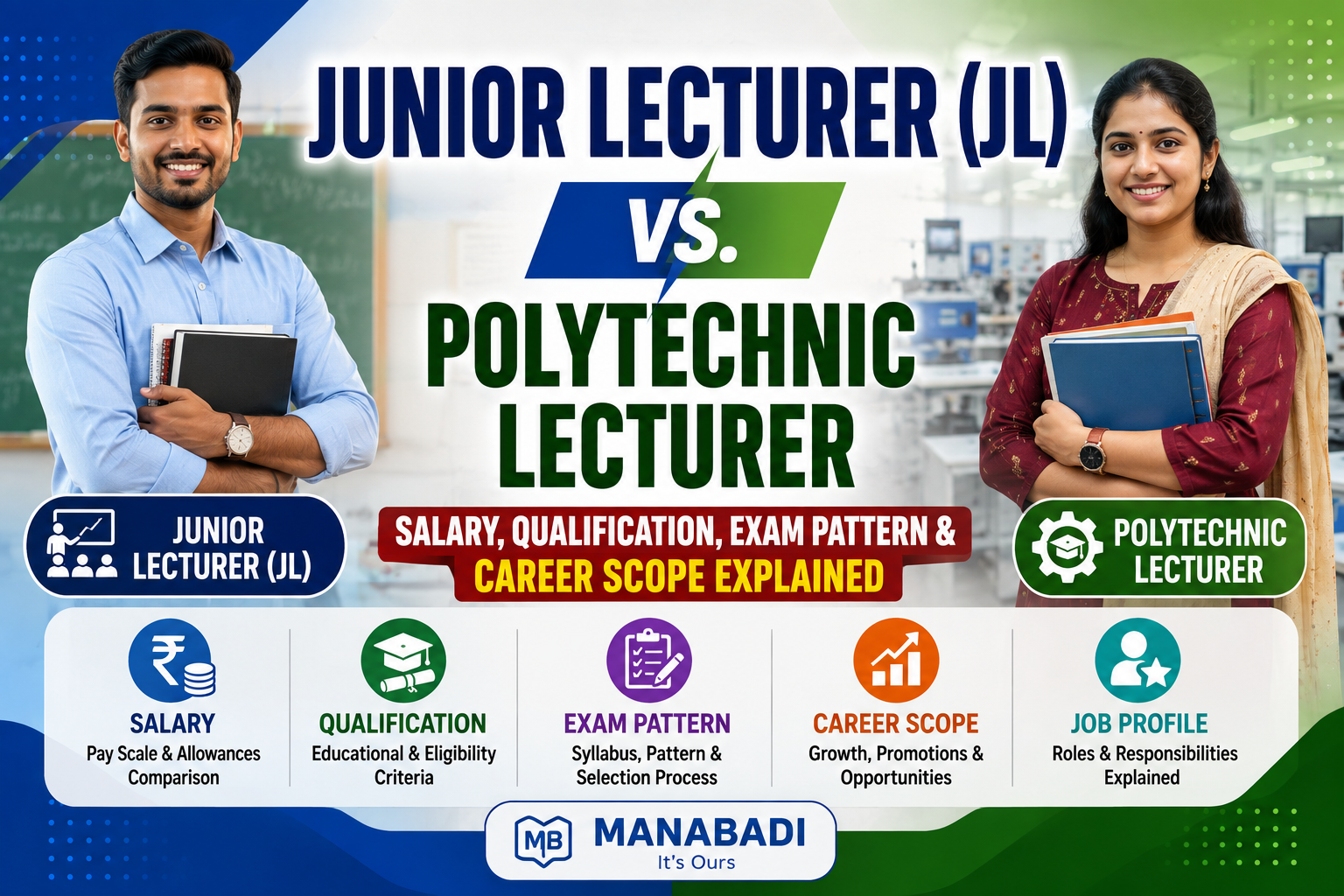
State Public Service Commission examinations (such as TSPSC/TGPSC, APPSC, UPPSC, and BPSC) offer prestigious, stable academic career paths in government institutions. Among the most sought-after posts are Junior Lecturers (JL) and Polytechnic Lecturers.
While both roles operate within higher secondary and tertiary education, they target different student profiles, follow distinct pay scales, and require separate qualification frameworks.
1. Role Comparison at a Glance
| Parameter | Junior Lecturer (JL) | Polytechnic Lecturer |
| Institution | Government Junior Colleges & Residential Colleges | Government Polytechnic Institutes |
| Target Student Base | Higher Secondary / Intermediate (Classes 11 & 12) | 3-Year Technical Diploma Students |
| Administrative Body | Board of Intermediate Education / School Education Dept | State Board of Technical Education (SBTET) / AICTE |
| Primary Domain | Pure Sciences, Arts, Commerce, Languages (MPC, BiPC, CEC) | Engineering Disciplines (Civil, Mech, EEE, ECE, CSE) & Sciences |
| Core Objective | Board exams & Competitive entrance foundations (JEE/NEET) | Hands-on engineering, lab experiments, industrial skills |
2. Eligibility & Educational Qualifications
Junior Lecturer (JL)
-
Academic Criteria: A Master’s Degree (Post-Graduation) in the relevant discipline (such as M.Sc, M.A., or M.Com) with at least 50% to 55% aggregate marks from a recognized university.
-
B.Ed / NET / SET: In most general state junior colleges, B.Ed or NET/SET is not mandatory for general JL recruitment, though specific residential welfare societies may require or give preference to B.Ed.
-
Age Bracket: Typically 18 to 44 years (with statutory state-level age relaxations for reserved categories).
Polytechnic Lecturer
-
Engineering Branches: First Class Bachelor’s Degree (B.E. / B.Tech / B.S.) in the appropriate engineering discipline as per AICTE norms. A Master’s degree (M.Tech) is advantageous and can lead to higher entry levels (Level 10).
-
Non-Engineering Branches (Maths, Physics, Chemistry, English): First Class Master’s Degree (M.Sc / M.A.) in the relevant subject.
-
Age Bracket: Typically 18 to 42/44 years depending on the specific state notification.
3. Exam Pattern & Selection Structure
State PSCs usually follow a two-tier objective written examination (CBT or OMR format) followed by Document Verification:
-
Paper 1 — General Studies & Mental Ability (150 Questions | 150 Marks)
-
Covers current affairs, regional state history and geography, Indian polity, general science, basic logical reasoning, and quantitative aptitude.
-
-
Paper 2 — Concerned Subject Domain (150 Questions | 300 Marks)
-
Evaluates subject mastery (2 marks per question).
-
For JL: Deep Post-Graduate level syllabus in the chosen core subject.
-
For Polytechnic: B.Tech/Engineering standard curriculum or PG-level syllabus for Science/Humanities streams.
-
-
Total Score & Merit: The combined merit is calculated out of 450 Marks, with no personal interview required in several states.
4. Salary Structure & Allowances
-
Polytechnic Lecturer: Regulated under AICTE/UGC pay bands. Entry-level B.Tech appointees are typically placed in Level 9A (Entry Basic: ₹56,100), while M.Tech holders are placed in Level 10 (Entry Basic: ₹57,700). Along with Dearness Allowance (DA) and House Rent Allowance (HRA), the starting gross monthly salary ranges between ₹75,000 and ₹88,000.
-
Junior Lecturer: Governed by State Intermediate Educational Pay Scales. In states with revised pay scales (like Telangana PRC), the basic pay ranges from ₹54,220 to ₹1,33,630, resulting in a gross monthly remuneration of approximately ₹70,000 to ₹80,000 depending on location posting.
5. Daily Responsibilities & Career Growth
Work Profile Differences
-
JLs emphasize structured classroom lectures, student tracking, foundational theory, board practical examinations, and entrance examination orientation.
-
Polytechnic Lecturers spend substantial hours in workshops, surveying camps, CAD/computer laboratories, overseeing student capstone diploma projects, and facilitating technical industry internships.
Promotion Pathways
-
JL Career Line: Junior Lecturer $\rightarrow$ Degree College Lecturer (DL) / Junior College Principal $\rightarrow$ Degree College Principal $\rightarrow$ Regional Joint Director (RJD) of Intermediate Education.
-
Polytechnic Career Line: Lecturer $\rightarrow$ Senior Lecturer $\rightarrow$ Head of Section (HoS / HOD) $\rightarrow$ Polytechnic Principal $\rightarrow$ Joint Director / Director of Technical Education.
Frequently Asked Questions (FAQs)
Q1: Can a B.Tech graduate apply for the Junior Lecturer (JL) exam?
No. Junior Lecturer positions require a Master’s degree (M.Sc, M.A., M.Com) in the relevant subject domain. B.Tech graduates are eligible for Polytechnic Lecturer engineering posts.
Q2: Is B.Ed compulsory for Junior Lecturer or Polytechnic Lecturer recruitment?
For general government colleges, B.Ed is usually not compulsory for either role, as post-graduation (for JL) or first-class graduation/PG (for Polytechnic) forms the primary eligibility. However, specific residential welfare societies may list B.Ed as an essential or preferred condition.
Q3: Which post offers a higher starting salary: JL or Polytechnic Lecturer?
Polytechnic Lecturers generally begin on AICTE Level 9A/10 pay scales (Basic ₹56,100–₹57,700), giving them a slightly higher initial basic pay compared to standard state junior teaching scales.
Q4: How should an aspirant divide study time between Paper 1 and Paper 2?
Because Paper 2 accounts for 300 out of 450 total marks (66.7% of the total score), dedicate at least 70% of your daily preparation hours to the subject core and 30% to General Studies and Aptitude.
Conclusion
Choosing between a Junior Lecturer and a Polytechnic Lecturer post comes down to your educational background and career orientation. If your expertise lies in pure sciences, commerce, or humanities and you enjoy foundational academic teaching, the Junior Lecturer path offers a direct route into higher secondary education. If you hold an engineering degree or applied science background and prefer laboratory-driven, skill-focused technical instruction, the Polytechnic Lecturer role provides a well-compensated, hands-on teaching career.